Artificial Intelligence (AI) is changing the way businesses operate, communicate, and manage their daily activities. In Malaysia, organisations are increasingly exploring AI tools to improve efficiency, reduce repetitive work, and support better decision-making. From preparing documents to analysing business information, AI offers various opportunities for employees to complete their tasks more effectively.
However, simply introducing AI tools into the workplace does not guarantee better productivity. Employees need to understand how these tools work, when to use them, and how to review their outputs before applying them to real business tasks. Without proper guidance, AI may be underused or produce results that require significant correction.
This is where AI training in Malaysia becomes valuable. By providing employees with practical knowledge and hands-on experience, businesses can help their teams use AI more confidently, improve existing workflows, and adapt to changing workplace demands.
What Is AI Training?
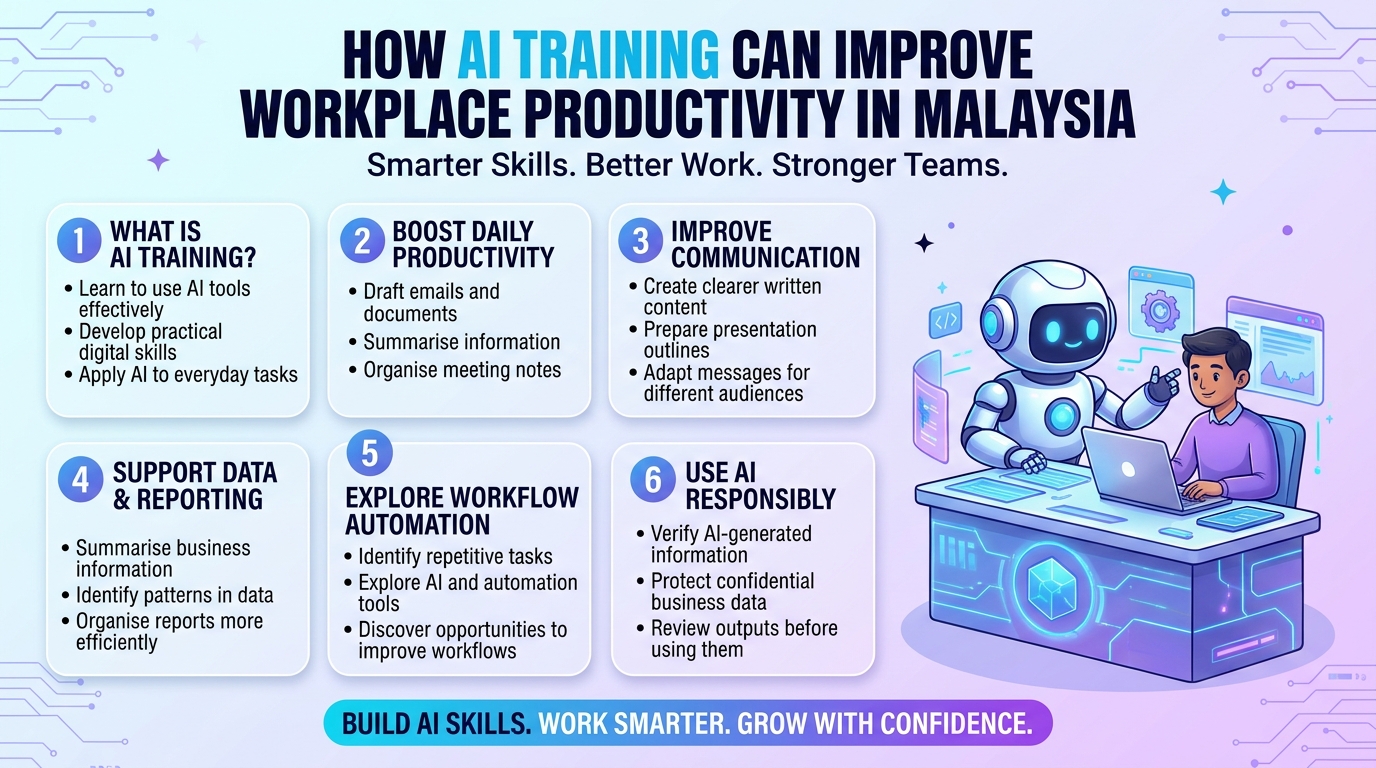
AI training helps employees understand artificial intelligence and learn how to apply AI tools to their daily responsibilities. Depending on the training programme, participants may learn about AI fundamentals, prompt writing, content generation, data analysis, workflow automation, and responsible AI usage.
For businesses, AI training should go beyond explaining what AI is. It should show employees how to use AI to solve practical workplace challenges and improve the way they complete their work.
For example, employees may learn how to use AI to prepare a first draft of a report, summarise a lengthy document, organise meeting notes, or develop ideas for a presentation. These applications can help reduce the time spent on routine activities while allowing employees to focus on tasks that require human judgement and expertise.
Effective AI training also highlights the importance of checking AI-generated content. Employees should understand that AI can make mistakes, misunderstand instructions, or provide information that is incomplete. Learning how to verify results is an essential part of using AI responsibly.
Why Is AI Training Important for Malaysian Businesses?
As workplace technology continues to develop, businesses need employees who can adapt to new tools and working methods. AI training can help organisations build these capabilities while supporting their wider digital transformation efforts.
1. Improve Employee Productivity
Many employees spend a significant amount of time on repetitive administrative tasks, including drafting emails, preparing documents, organising information, and summarising reports.
AI tools can assist with some of these activities by generating initial drafts, organising information, and helping employees structure their work. With appropriate training, employees can learn to use these tools more effectively instead of completing every step manually.
This does not mean AI should replace the employee’s role. Rather, it can support everyday work and give employees more time to concentrate on activities that require critical thinking, creativity, communication, and problem-solving.
2. Develop Essential Digital Skills
Digital skills are becoming increasingly important across different industries. Employees who understand how to use AI tools may be better prepared to adapt to changing workplace requirements and new business processes.
AI training introduces employees to practical skills they can apply in their current roles. These may include writing effective prompts, reviewing AI-generated content, organising information, and identifying tasks where AI assistance may be useful.
Developing these skills can also help businesses build a workforce that is more confident when adopting new technology.
3. Support Better Decision-Making
AI tools can help employees organise information, identify possible patterns, and summarise large amounts of text. These capabilities may support business planning and decision-making when used appropriately.
For example, a team may use AI to summarise customer feedback, organise research findings, or prepare an initial overview of business information. Employees can then review the results and combine them with their own knowledge before making decisions.
AI should be treated as a support tool rather than the final decision-maker. Human judgement, reliable information, and appropriate verification remain important, especially when decisions affect customers, employees, finances, or business operations.
4. Encourage Workplace Innovation
AI training can encourage employees to explore different ways of completing their tasks. Instead of following the same manual processes, they can learn to identify opportunities where AI may help improve efficiency or simplify complicated workflows.
This can encourage teams to share ideas, experiment with suitable tools, and review existing processes. Over time, employees may discover practical improvements that support the organisation’s broader productivity goals.
How AI Training Can Improve Daily Workplace Tasks
One of the main benefits of AI training is that employees can apply what they learn directly to their everyday responsibilities. The most suitable applications depend on the employee’s role, the available tools, and the organisation’s requirements.
1. Writing Emails and Business Documents
Employees often need to prepare emails, reports, proposals, meeting summaries, and other business documents. AI tools can help generate initial drafts, improve sentence structure, and organise ideas.
With proper training, employees can learn how to provide clear instructions, specify the intended audience, and request an appropriate tone. They can then review and personalise the output to ensure it accurately reflects the purpose of the communication.
For example, an employee may use AI to prepare a first draft of a client email before checking the details and adjusting the message to suit the situation.
2. Preparing Presentations and Reports
Preparing presentations and reports often involves gathering information, organising key points, and creating a clear structure. AI can help employees develop outlines, summarise source material, and suggest ways to present information.
Employees can use these suggestions as a starting point rather than relying on AI to produce the entire final document. They should verify facts, check figures against reliable sources, and ensure that the final content meets the organisation’s standards.
This approach can make the preparation process more organised while keeping employees responsible for the quality of their work.
3. Summarising Information
Employees may need to review long documents, research materials, meeting notes, or internal reports. AI tools can assist by producing summaries that highlight important points and help employees navigate information more efficiently.
However, summaries may omit important details or misinterpret the original content. Employees should refer to the source material whenever accuracy is essential, particularly for contractual documents, policies, financial information, and other sensitive business content.
4. Organising Ideas and Planning Work
AI can also support brainstorming, task planning, and the organisation of project information. Employees may use it to develop an initial task list, arrange ideas into categories, or identify questions that need further investigation.
These suggestions can help teams get started more quickly, but they should be adjusted according to actual deadlines, available resources, business priorities, and team responsibilities.
By learning how to use AI as a planning assistant, employees can improve the way they organise their work without handing over important decisions to the technology.
Using AI to Improve Workplace Communication
Clear communication is essential for teamwork, customer service, and business operations. AI tools can help employees prepare messages that are easier to understand and better suited to different audiences.
For example, AI may assist with simplifying technical explanations, restructuring lengthy messages, or preparing a draft response to a common customer enquiry. It can also help employees generate alternative ways to communicate the same information.
AI training teaches employees how to provide context and specific instructions so the output is more relevant to the task. Employees should still check the tone, accuracy, and appropriateness of every message before sending it.
This is particularly important when communicating with customers, business partners, or colleagues about sensitive matters. AI can support the writing process, but personal judgement and an understanding of the audience remain essential.
The Role of AI in Data Analysis and Reporting
Businesses regularly work with data to monitor performance, understand customer needs, and review operational activities. Depending on the tools available, AI can help employees organise information, summarise findings, and explore possible patterns in data.
For instance, employees may use AI to prepare an initial summary of survey responses or identify themes in customer feedback. These findings can help teams decide which areas require further investigation.
AI training can also introduce employees to the limitations of AI-generated analysis. Results may be inaccurate if the input data is incomplete, unclear, or incorrectly interpreted. Employees must understand how to validate findings and check calculations against the original data.
When used carefully, AI can support reporting activities and help employees organise information more effectively. It should complement established data practices rather than replace proper analysis and verification.
Exploring AI and Workflow Automation
Some workplace activities involve repeating the same steps regularly, such as sorting information, preparing standard documents, or transferring details between systems. These activities may offer opportunities to improve workflows through suitable AI tools or automation solutions.
AI training can help employees recognise repetitive tasks and assess whether technology could simplify them. Participants can learn to map existing processes, identify time-consuming steps, and explore appropriate tools based on their work requirements.
Before introducing automation, businesses should consider the accuracy of the process, the sensitivity of the information involved, and the need for human review. Not every task should be automated, especially when it involves complex judgement, confidential information, or important customer decisions.
A practical approach is to begin with a manageable task, evaluate the results, and make improvements before expanding the solution to other workflows.
Who Can Benefit from AI Training?
AI training can benefit employees across different departments, although the tools and applications may vary according to their responsibilities.
- Administrative teams: Learn to draft documents, organise information, and prepare meeting summaries.
- Human resources professionals: Explore ways to assist with job description drafts, internal communications, and HR documentation while protecting employee information.
- Marketing teams: Use AI to brainstorm campaign ideas, prepare content outlines, and adapt messages for different audiences.
- Sales teams: Explore support for proposal drafts, customer research summaries, and sales communication.
- Managers and team leaders: Learn how AI may support planning, reporting, and workflow improvement.
- Business owners: Understand potential AI applications, limitations, and considerations when introducing AI into business operations.
AI training should be relevant to the participants’ actual work. Practical examples based on familiar tasks can make it easier for employees to understand how AI may fit into their daily routines.
How to Choose the Right AI Training Programme
Choosing a suitable AI training programme is an important step towards ensuring that employees can apply what they learn. Businesses should consider their current capabilities, operational needs, and intended outcomes before selecting a course.
1. Identify Your Business Needs
Start by identifying tasks that take up significant employee time or involve repetitive processes. Speak with team members to understand their challenges and determine where AI may offer practical support.
Clear objectives make it easier to select training that addresses real workplace needs rather than introducing tools without a defined purpose.
2. Look for Practical, Hands-On Learning
A useful training programme should provide opportunities for participants to practise using AI tools. Demonstrations, guided exercises, and workplace scenarios can help employees understand how to apply the concepts they learn.
Practical learning also allows participants to explore common mistakes and develop better habits when working with AI.
3. Consider Different Employee Skill Levels
Employees may have different levels of familiarity with AI. Some may be new to the technology, while others may already use AI tools but need to improve their techniques.
A suitable programme should match participants’ experience and provide clear guidance that they can follow and apply confidently.
4. Prioritise Responsible AI Usage
Training should cover accuracy, privacy, confidentiality, and human oversight. Employees need to understand which information can be shared with approved AI tools and which information must remain protected.
Organisations should also establish internal guidelines for reviewing AI-generated content and deciding when human approval is required.
5. Evaluate the Results After Training
Businesses should review whether employees are applying their new skills and whether the training supports the intended objectives. Feedback from participants can help identify areas where further guidance may be needed.
Depending on the task, organisations may evaluate factors such as time spent on routine work, document quality, consistency, or employee confidence when using approved AI tools.
Measuring these outcomes can help businesses understand the value of training and identify opportunities for continued improvement.
Building a More Productive Workforce with AI Training
Introducing AI into the workplace is not only about adopting new technology. It also involves helping employees develop the knowledge and confidence to use that technology appropriately.
When employees understand how to work with AI, they can explore new ways to organise tasks, prepare information, improve communication, and support everyday business activities. At the same time, they need to maintain responsibility for accuracy, confidentiality, and the quality of their final work.
Businesses that approach AI training with clear objectives and practical learning opportunities can create a stronger foundation for digital skills development. Rather than expecting immediate results from technology alone, organisations can focus on helping employees build sustainable habits that support productivity over time.
Conclusion
AI training can help Malaysian businesses prepare their employees for a workplace where digital tools are becoming increasingly relevant. From drafting documents and summarising information to improving communication and exploring workflow automation, AI offers practical ways to support everyday work.
However, successful implementation requires more than access to AI tools. Employees need appropriate training, clear guidelines, and the ability to review AI-generated results before using them in business activities.
By investing in relevant AI training, organisations can help their teams develop useful digital skills, work more efficiently, and approach new technology with greater confidence.
FAQs
1. What is AI training for employees?
AI training for employees helps individuals understand artificial intelligence and learn how to use AI tools for suitable workplace tasks. It may cover prompt writing, content generation, information summarisation, data-related tasks, workflow improvement, and responsible AI usage.
2. How can AI training improve workplace productivity?
AI training can help employees use AI tools to assist with routine tasks, organise information, prepare initial drafts, and improve work processes. The actual benefits depend on the tasks involved, the tools used, and how effectively employees apply their training.
3. Is AI training suitable for employees without technical experience?
Yes. Introductory AI training can be suitable for employees with little or no technical experience, provided the programme matches their skill levels. Practical examples and guided exercises can help participants understand how to use AI tools in everyday work.
4. Which departments can benefit from AI training?
Departments such as administration, human resources, marketing, sales, operations, and management may benefit from AI training. The most suitable applications depend on each department’s responsibilities and the organisation’s policies.
5. Can AI replace employees in the workplace?
AI can assist with certain tasks, but it does not remove the need for human judgement, accountability, creativity, and communication. Businesses should evaluate AI based on how it can support employees and improve appropriate workflows.