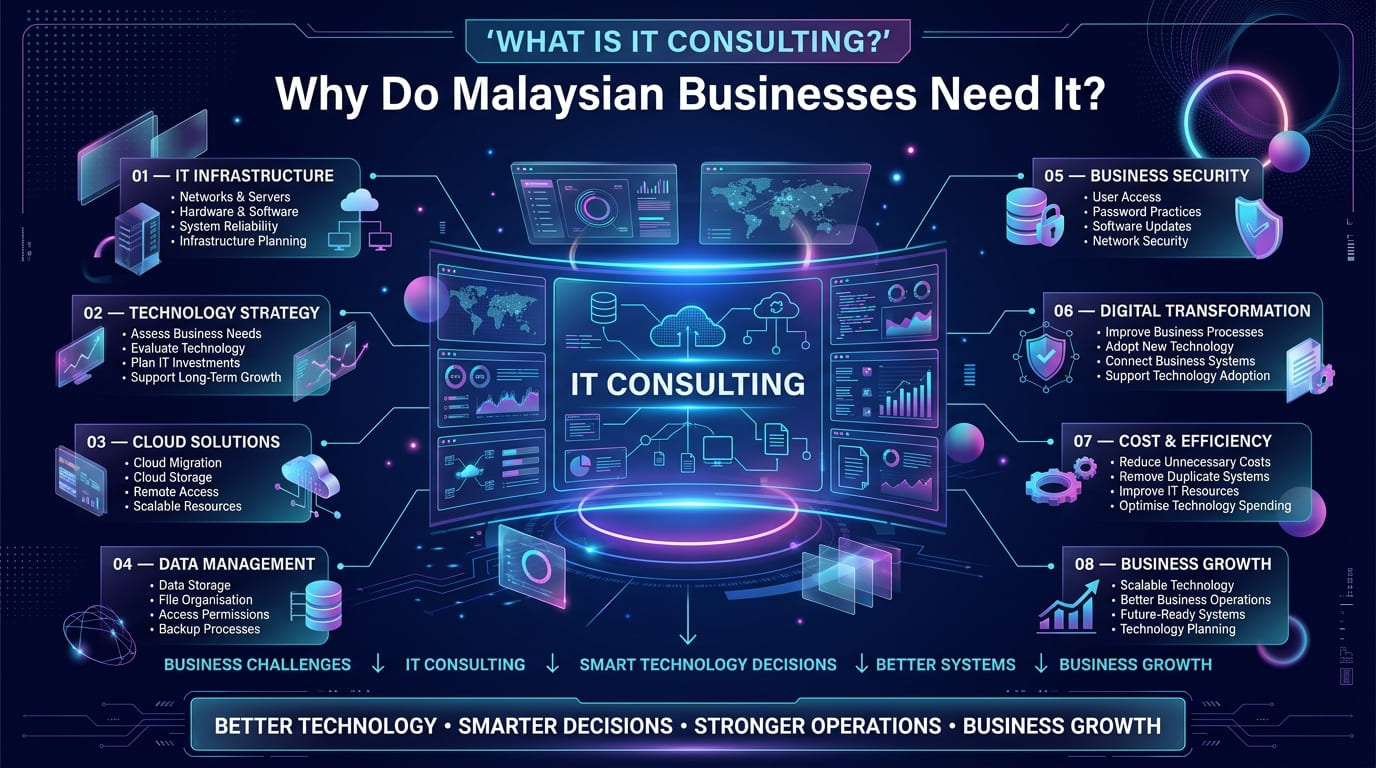
Technology has become an important part of how modern businesses operate. From communication systems and cloud platforms to business software and digital infrastructure, companies rely on technology to manage daily operations and support long-term growth.
However, choosing the right technology and managing different IT systems can be challenging, especially for businesses without an experienced internal IT team. Many Malaysian businesses find themselves juggling multiple systems, dealing with outdated infrastructure, or unsure whether their technology investments are actually delivering value.
Some businesses rely on ad-hoc solutions buying software when a problem arises, upgrading hardware only when it fails, or asking employees to “figure it out” when technology issues occur. While this approach may work in the short term, it often leads to bigger problems down the road: systems that do not integrate, data that is scattered across different platforms, security gaps, and rising costs.
This is where IT consulting services in Malaysia can provide valuable support. IT consultants bring expertise, experience, and a structured approach to help businesses make better technology decisions.
What Is IT Consulting?
IT consulting is a professional service that helps businesses plan, implement, manage, and improve their technology systems.
IT consultants work with businesses to understand their current technology environment, identify problems, and recommend suitable solutions based on their business requirements.
Unlike general IT support, which focuses on fixing day-to-day technical issues, IT consulting takes a broader, more strategic view. Consultants look at the big picture — how technology supports business goals, where inefficiencies exist, and what improvements can be made. They act as trusted advisors, helping business leaders understand their options and make informed decisions.
IT consulting can cover areas such as:
-
IT infrastructure – Servers, networks, computers, and physical technology systems that form the backbone of business operations.
-
Business software – Applications for finance, HR, operations, sales, customer management, and other business functions.
-
Cloud solutions – Cloud storage, cloud applications, and cloud infrastructure that provide flexibility and scalability.
-
Network systems – Internet connectivity, internal networks, and communication systems that keep teams connected.
-
Data management – How data is stored, accessed, organized, backed up, and protected.
-
Cybersecurity – Protecting business systems and data from threats, breaches, and unauthorized access.
-
Technology planning – Developing short-term and long-term technology strategies aligned with business goals.
-
Digital transformation – Using technology to improve business operations, services, and customer experiences.
Instead of investing in technology without a clear strategy, businesses can use IT consulting to make more informed technology decisions.
For Malaysian businesses, this can mean the difference between spending on technology that delivers real value and spending on tools that create more problems than they solve. It can also mean the difference between reacting to technology problems and proactively planning for future needs.
Why Do Malaysian Businesses Need IT Consulting?
As businesses become more dependent on technology, IT systems need to be reliable, scalable, and suitable for business operations.
For Malaysian businesses, IT consulting can help address common challenges such as outdated systems, inefficient processes, technology costs, security concerns, and difficulties managing multiple IT solutions.
Many businesses in Malaysia are growing quickly, adopting new tools, and trying to keep up with digital trends. Without proper planning, this can lead to a fragmented technology environment where systems do not work well together, data is scattered, and costs spiral out of control. Employees may become frustrated with slow or unreliable systems, and business leaders may struggle to understand whether their technology investments are paying off.
An IT consultant can help businesses evaluate their current systems and identify areas where technology can be improved. They can also help businesses avoid common pitfalls, such as investing in technology that is not suitable for their needs or failing to plan for future growth.
For Malaysian SMEs in particular, IT consulting can provide access to expertise that may not be available in-house. Instead of hiring a full-time IT team, businesses can work with consultants on a project or retainer basis to get the guidance they need.
Improve IT Infrastructure
A reliable IT infrastructure provides the foundation for many business operations.
Businesses may depend on networks, servers, cloud platforms, computers, software, and other technology systems every day. If these systems are poorly planned or outdated, they can affect productivity and business operations.
For example, slow networks can frustrate employees and reduce productivity. Outdated servers can cause downtime and data loss. Incompatible systems can create data silos, where information is trapped in one department and cannot be easily shared with others. These issues may seem minor at first, but over time they can significantly impact business performance.
IT consultants can help businesses:
-
Assess existing IT infrastructure – Review current systems, identify strengths and weaknesses, and understand how well the infrastructure supports business operations.
-
Identify technology weaknesses – Find bottlenecks, single points of failure, outdated components, and areas where performance or reliability could be improved.
-
Plan infrastructure improvements – Develop a roadmap for upgrades and enhancements, prioritized based on business impact and budget.
-
Recommend suitable hardware and software – Suggest technology that matches business needs, budget, and future growth plans.
-
Improve system reliability – Reduce downtime, improve performance, and ensure systems are available when needed.
-
Prepare technology systems for future growth – Ensure infrastructure can scale as the business grows, avoiding the need for costly replacements later.
A well-planned IT infrastructure can help businesses create a stronger foundation for their digital operations.
For Malaysian businesses, this is particularly important as more operations move online and dependence on technology increases. A reliable infrastructure can support everything from email and file sharing to customer-facing systems and business-critical applications.
Choose the Right Business Technology
There are many technology solutions available today, but not every solution is suitable for every business.
Businesses may need to choose between different software platforms, cloud services, collaboration tools, databases, and other technology solutions. With so many options available, it can be difficult to know which one is right. Sales pitches, online reviews, and industry trends can all influence decisions, but what works for one business may not work for another.
IT consultants can help evaluate these options based on factors such as:
-
Business requirements – What does the business actually need? What problems need to be solved?
-
Budget – What is affordable and delivers good value? What is the total cost of ownership?
-
Scalability – Can the solution grow with the business? Will it still be suitable in 3-5 years?
-
Compatibility – Does it work with existing systems? Will it integrate with other tools?
-
Security – Does it meet security and compliance requirements? How is data protected?
-
Ease of use – Will employees be able to use it effectively? Is training required?
-
Long-term business needs – Will it support future plans and growth?
This allows businesses to focus on technology that supports their actual requirements rather than simply adopting the latest available tools.
For Malaysian businesses, this guidance can save time, money, and frustration. Instead of trial and error, businesses can make informed decisions based on expert advice. They can also avoid the trap of buying technology that looks good on paper but does not work well in practice.
Reduce Technology Costs
Technology investments can become expensive when businesses purchase unnecessary software, hardware, or services.
Many businesses end up paying for subscriptions they do not use, maintaining hardware that should be replaced, or running duplicate systems that could be consolidated. Over time, these small inefficiencies can add up to significant unnecessary spending.
IT consulting can help businesses review their current technology spending and identify opportunities to improve efficiency.
For example, an IT consultant may identify:
-
Unused software subscriptions – Licenses that are paid for but not used by employees. This is common when businesses purchase software for a project that has ended or for employees who have left.
-
Outdated hardware – Equipment that is costly to maintain and should be replaced. Older hardware often consumes more energy, requires more support, and is more prone to failure.
-
Duplicate systems – Overlapping tools that could be consolidated. For example, using multiple file storage platforms when one would suffice.
-
Inefficient technology processes – Workflows that waste time and resources. Manual processes that could be automated, or approval chains that could be streamlined.
-
Infrastructure that needs to be upgraded – Systems that are holding the business back and costing more to maintain than to replace.
-
Opportunities to move suitable systems to the cloud – Reducing on-premise costs and improving flexibility.
Better technology planning can help businesses manage IT expenses more effectively.
For Malaysian businesses, especially SMEs with limited budgets, this can free up resources for other business priorities. It can also help businesses avoid the cycle of constant spending on technology without seeing clear returns.
Support Digital Transformation
Digital transformation involves using technology to improve how a business operates, communicates, and delivers services.
However, digital transformation is not simply about purchasing new technology. Businesses also need a clear strategy for implementing and managing those technologies.
Many digital transformation initiatives fail because businesses focus on the technology rather than the business outcomes. They buy new tools without understanding how those tools will improve operations or deliver value. Employees may resist change, systems may not integrate properly, and expected benefits may not materialize.
IT consultants can help businesses plan digital transformation by:
-
Assessing existing systems – Understanding the current technology landscape and identifying what works and what does not.
-
Identifying areas for improvement – Finding processes that can be automated, streamlined, or eliminated.
-
Recommending suitable technologies – Suggesting tools that address specific business needs and align with strategic goals.
-
Planning implementation – Developing a phased approach to adoption that minimizes disruption and maximizes value.
-
Supporting technology adoption – Helping employees adapt to new systems through training and change management.
-
Reviewing the results – Measuring the impact of digital transformation initiatives and making adjustments as needed.
With the right approach, businesses can introduce new technology while keeping their operations organised.
For Malaysian businesses, digital transformation is not just a trend — it is a necessity to remain competitive in an increasingly digital economy. Customers expect digital convenience, employees expect modern tools, and competitors are constantly raising the bar.
Improve Data Management
Businesses generate and manage large amounts of information every day.
Customer information, financial records, business documents, employee data, reports, and operational information all need to be managed properly. Poor data management can lead to lost files, security breaches, compliance issues, and inefficient workflows. Employees may waste time searching for information, or may make decisions based on outdated or incorrect data.
IT consulting can help businesses review how their data is stored, accessed, managed, and protected.
This can include improving:
-
Data storage – Where and how data is stored, including cloud and on-premise options.
-
File organisation – How files are structured, named, and categorized for easy retrieval.
-
Access permissions – Who can access what data, and under what conditions.
-
Backup processes – How data is backed up, how often, and how recovery is tested.
-
Data workflows – How data moves through the business, from creation to storage to use.
-
Information management systems – Tools for managing, searching, and reporting on business information.
Better data management can make it easier for employees to find and use important business information.
For Malaysian businesses, good data management is also important for compliance with regulations like the Personal Data Protection Act (PDPA). Businesses that handle personal data need to ensure it is stored securely, accessed appropriately, and protected from unauthorized use.
Support Cloud Technology Adoption
Cloud technology has become an important part of modern business operations.
Businesses can use cloud platforms for file storage, collaboration, software applications, communication, data management, and other business functions. Cloud technology offers flexibility, scalability, and cost efficiency — but only if implemented properly.
However, moving to the cloud requires proper planning. Businesses need to consider which systems to move, how to migrate data, how to manage access, and how to control costs. Rushing into cloud adoption without a clear strategy can lead to problems such as data loss, security gaps, unexpected costs, and employee frustration.
IT consultants can help businesses determine:
-
Which systems can move to the cloud – Not everything is suitable for cloud migration. Some systems may be better kept on-premise for performance, security, or compliance reasons.
-
Which cloud solutions are suitable – There are many cloud platforms and services available, each with different features, pricing, and capabilities.
-
How data should be migrated – Planning the migration process to avoid disruption, data loss, or downtime.
-
How employees can access cloud systems – Ensuring secure and convenient access from different devices and locations.
-
How cloud resources should be managed – Managing costs, performance, security, and compliance.
-
How to plan for future requirements – Ensuring cloud solutions can scale as the business grows.
This can help businesses adopt cloud technology in a more structured way.
For Malaysian businesses, cloud adoption can improve flexibility, reduce costs, and support remote work — but only if planned and implemented properly. An IT consultant can help businesses navigate the options and avoid common pitfalls.
Improve Technology Security
Technology systems need to be protected as businesses become increasingly dependent on digital tools.
Cyber threats are becoming more sophisticated, and businesses of all sizes are at risk. A security breach can result in data loss, financial damage, reputational harm, and legal consequences. Small businesses may think they are not targets, but attackers often target smaller organisations precisely because they have weaker defenses.
IT consultants can help businesses review their technology environment and identify areas that may require stronger security controls.
This may include reviewing:
-
User access – Who has access to what systems and data, and whether access is appropriate.
-
Password practices – Are strong passwords enforced? Is multi-factor authentication used?
-
Software updates – Are systems patched and up to date? Are security updates applied promptly?
-
Data backups – Are backups performed regularly and tested? Can data be recovered if needed?
-
Network security – Are networks protected from unauthorized access? Are firewalls and other controls in place?
-
Device management – Are devices secured and monitored? Are mobile devices managed?
-
Security policies – Are there clear rules for technology use? Are employees trained on security best practices?
Businesses can then develop better technology practices to reduce unnecessary risks and protect important business information.
For Malaysian businesses, cybersecurity is not just a technical issue — it is a business risk that needs to be managed. An IT consultant can help businesses understand their risks and implement appropriate controls.
Support Business Growth
Technology requirements can change as a business grows.
A system that works for a small company may not be suitable when the company has more employees, customers, data, or business locations. Systems that were adequate at 10 employees may struggle at 50. Software that worked for one location may not support multiple branches. Data storage that was sufficient last year may be full this year.
IT consulting can help businesses plan technology systems that can grow alongside the organisation.
This may involve:
-
Scaling cloud resources – Adding capacity as needed, without major upfront investment.
-
Upgrading infrastructure – Improving performance and reliability to support more users and data.
-
Improving business software – Moving to more capable platforms that can handle increased complexity.
-
Supporting additional users – Ensuring systems can handle more people, devices, and locations.
-
Connecting different systems – Integrating tools for better workflows and data sharing.
-
Planning future technology investments – Preparing for future needs based on business plans.
Having a technology strategy can make it easier for businesses to adapt as their requirements change.
For Malaysian businesses with growth ambitions, this can help avoid the pain of outgrowing technology systems and having to replace them prematurely. It can also help businesses plan their technology investments in line with their growth plans.
When Should a Business Consider IT Consulting?
Businesses do not necessarily need to wait until they experience a major IT problem before seeking professional advice.
IT consulting may be useful when a business is:
-
Expanding its operations – Growing teams, locations, or services that require more robust technology.
-
Moving to new technology – Adopting new software, cloud, or systems that need proper planning.
-
Experiencing recurring IT problems – Frequent downtime, slow systems, or security issues that keep coming back.
-
Upgrading its infrastructure – Replacing or improving technology systems to support business needs.
-
Moving systems to the cloud – Planning cloud migration and managing the transition.
-
Managing multiple software platforms – Dealing with integration challenges and data silos.
-
Improving data management – Organizing and protecting business data more effectively.
-
Planning digital transformation – Developing a technology strategy aligned with business goals.
-
Reviewing IT costs – Looking for ways to reduce spending and improve efficiency.
-
Building a long-term technology strategy – Planning for future growth and technology needs.
Getting professional guidance early can help businesses plan technology investments more effectively.
For Malaysian businesses, early IT consulting can prevent small issues from becoming major problems. It can also help businesses take advantage of opportunities that technology can enable.
How to Choose IT Consulting Services in Malaysia
When looking for IT consulting services in Malaysia, businesses should consider whether the consultant understands their business requirements and technology environment.
Important factors to consider include:
-
Experience with similar businesses – Has the consultant worked with businesses like yours? Do they understand your industry?
-
Range of IT services – Can they cover your specific needs, from infrastructure to software to security?
-
Understanding of business objectives – Do they understand your goals and how technology can support them?
-
Technical expertise – Are they qualified and experienced? Do they have relevant certifications?
-
Scalability of solutions – Can their recommendations grow with you as your business expands?
-
Ongoing support – Will they provide support after implementation? What does ongoing support look like?
-
Clear communication – Can they explain technical concepts clearly to non-technical stakeholders?
-
Ability to provide practical recommendations – Are their suggestions actionable and realistic for your business?
The right IT consulting approach should focus on solving business problems rather than simply introducing more technology.
For Malaysian businesses, working with a local IT consultant who understands the Malaysian business environment can be particularly valuable. They can provide guidance that is relevant to local regulations, business practices, and technology availability.
Why IT Consulting Matters for Malaysian Businesses
Technology plays an increasingly important role in business operations, but managing technology effectively requires proper planning and expertise.
IT consulting gives businesses access to professional guidance when they need to evaluate technology, improve infrastructure, adopt new systems, manage data, or plan future technology investments.
For Malaysian businesses looking to strengthen their technology capabilities, IT consulting services can provide a structured approach to making better technology decisions and supporting long-term business growth.
In a competitive business environment, the ability to use technology effectively can be a significant advantage. IT consulting helps businesses unlock that advantage.
Whether you are a small business looking to improve your IT setup or a larger organisation planning digital transformation, IT consulting can provide the expertise and guidance you need to succeed.
Conclusion
IT consulting can help Malaysian businesses understand their technology needs, improve existing systems, and plan for future growth. From infrastructure and cloud solutions to software and data management, professional IT guidance can help businesses use technology more effectively. Instead of making technology decisions based on guesswork or trends, businesses can rely on expert advice to choose solutions that truly fit their operations and budget.
As technology continues to shape the modern workplace, having a clear IT strategy can help businesses build stronger and more adaptable operations. Technology is no longer just a support tool, it is a core part of how businesses compete, serve customers, and grow. Without proper planning, businesses risk falling behind or wasting resources on systems that do not deliver value.
For Malaysian businesses looking to improve their technology capabilities, IT consulting is not just an option, it is a strategic investment in the future of the business. Whether you are a small company taking your first steps into digital transformation or an established organisation looking to upgrade your systems, the right IT consulting partner can help you move forward with confidence.
FAQs
1. What is IT consulting?
IT consulting is a professional service that helps businesses plan, implement, manage, and improve their technology systems. IT consultants work with businesses to understand their current technology environment, identify problems, and recommend suitable solutions based on their business requirements.
2. Why do Malaysian businesses need IT consulting?
Malaysian businesses need IT consulting to address common challenges such as outdated systems, inefficient processes, technology costs, security concerns, and difficulties managing multiple IT solutions. IT consulting provides expert guidance to help businesses make better technology decisions.
3. What services do IT consultants provide?
IT consultants provide services such as IT infrastructure assessment, business software selection, cloud solutions, network systems, data management, cybersecurity, technology planning, and digital transformation support.
4. How can IT consulting help reduce technology costs?
IT consulting can help businesses review their current technology spending and identify opportunities to improve efficiency. This may include identifying unused software subscriptions, outdated hardware, duplicate systems, and opportunities to move suitable systems to the cloud.
5. When should a business consider IT consulting?
A business should consider IT consulting when expanding operations, moving to new technology, experiencing recurring IT problems, upgrading infrastructure, moving systems to the cloud, managing multiple software platforms, improving data management, planning digital transformation, reviewing IT costs, or building a long-term technology strategy.