Technical expertise and domain knowledge provide employees with the foundational tools to perform their daily duties, but soft skills dictate how effectively they apply that knowledge alongside others. In today’s rapidly evolving corporate landscape, technical competence alone is no longer enough to drive sustainable organizational growth. Modern businesses require adaptable professionals who can articulate ideas clearly, navigate complex problem-solving scenarios, adapt smoothly to unexpected industry shifts, and collaborate cross-functionally under pressure. When these core interpersonal competencies are missing, even the most skilled teams suffer from operational silos, miscommunication, and missed performance benchmarks.
Soft skills training bridges this gap by offering employees a structured framework to sharpen their communication, emotional intelligence, and daily professionalism. Strengthening these core competencies elevates personal confidence and improves everyday interactions across all levels of an organization.
Furthermore, as businesses accelerate digital transformation and integrate complex technologies like automation and artificial intelligence into standard workflows, the uniquely human capacity for creative problem-solving and empathetic collaboration becomes exponentially more valuable. Combining high-level technical expertise with strong interpersonal skills equips organizations to build resilient, high-performing teams capable of thriving through ongoing change.
What Are Soft Skills?
While hard skills cover the specific tasks of a job role, soft skills govern how effectively employees interact, share ideas, and navigate daily workplace friction. Cultivating these capabilities ensures individual expertise translates directly into collective organizational success.
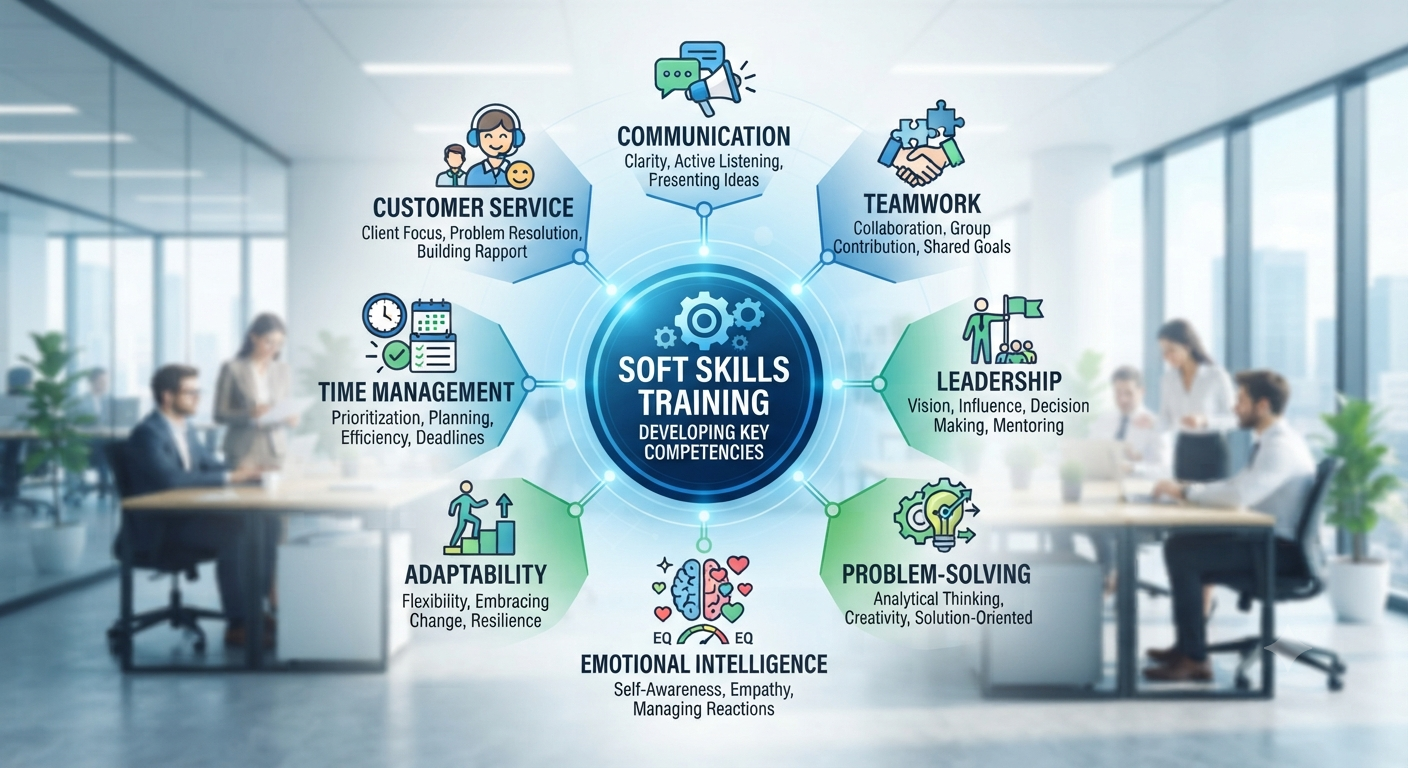
Soft skills are personal and interpersonal abilities that influence how people communicate, collaborate, and handle workplace challenges.
Common soft skills include:
- Communication
- Teamwork
- Problem-solving
- Leadership
- Time management
- Adaptability
- Emotional intelligence
These skills complement technical knowledge and enable employees to perform more effectively in any industry.
Improve Workplace Communication
Miscommunication is the leading cause of wasted time and friction in the modern workplace. Soft skills training gives employees the structural toolkit to convey complex concepts clearly, listen with intent, and align on goals across departments without friction.
Clear communication helps reduce misunderstandings and improves collaboration across teams.
Soft skills training can help employees:
- Express ideas confidently
- Listen actively
- Provide constructive feedback
- Communicate professionally
- Build stronger working relationships
Good communication creates a more productive and positive work environment.
Strengthen Team Collaboration
High-performing teams aren’t built by chance; they are forged through deliberate, continuous skill development. Soft skills training breaks down operational silos, encouraging employees to bridge departmental divides and align their daily efforts around shared organizational outcomes.
Successful organizations rely on employees who work well together.
Training helps team members:
- Collaborate effectively
- Respect different perspectives
- Share responsibilities
- Resolve conflicts professionally
- Support common business goals
Stronger teamwork often leads to higher productivity and better project outcomes.
Develop Better Problem-Solving Skills
Unexpected challenges are inevitable, but how quickly teams adapt defines operational success. Soft skills training equips employees with the critical thinking frameworks needed to evaluate complex scenarios objectively, pivot under pressure, and drive continuous workplace improvement.
Every workplace faces challenges that require thoughtful decision-making.
Employees with strong problem-solving skills are better able to:
- Identify issues quickly
- Evaluate possible solutions
- Make informed decisions
- Adapt to changing situations
- Improve workplace efficiency
These abilities contribute to smoother daily operations and continuous improvement.
Build Future Leaders
Leadership capability shouldn’t be reserved exclusively for top-tier executives—it flourishes at every operational level. Soft skills training empowers individual contributors to step up, take ownership of their outcomes, and drive positive influence across their teams long before taking on a formal title.
Leadership is not only for managers.
Soft skills training helps employees develop qualities such as:
- Confidence
- Accountability
- Decision-making
- Motivation
- Coaching and mentoring
These leadership skills prepare employees to take on greater responsibilities as they progress in their careers.
Adapt to Workplace Changes
In an era of relentless technological shifts, technical tools quickly become obsolete, but adaptive mindsets remain permanently relevant. Soft skills training instills the mental flexibility needed to navigate digital transitions seamlessly, helping teams embrace innovation rather than resist it.
Modern workplaces continue to evolve with new technologies, changing customer expectations, and digital transformation.
Employees who develop strong soft skills are better equipped to:
- Learn new systems
- Embrace change
- Work with diverse teams
- Manage workplace challenges
- Remain productive during transitions
Adaptability is becoming one of the most valuable workplace skills.
Increase Employee Confidence
Confidence in the workplace isn’t an innate trait—it’s a direct byproduct of skill mastery and practice. Soft skills training gives employees the structural frameworks and self-assurance they need to speak up, take calculated risks, and represent their teams with total professionalism.
Training provides employees with practical tools they can apply immediately.
As their communication, teamwork, and leadership skills improve, employees often become more confident when:
- Speaking in meetings
- Presenting ideas
- Working with clients
- Managing responsibilities
- Solving workplace problems
Greater confidence contributes to improved overall performance.
Why Businesses Invest in Soft Skills Training
Investing in your workforce pays massive dividends across every core operational metric. Prioritizing soft skills development creates a strong compound effect, yielding a resilient business model supported by adaptable talent and clear, continuous leadership pipelines.
Organizations that prioritise employee development often benefit from:
- Better teamwork
- Improved communication
- Higher employee engagement
- Increased productivity
- Stronger leadership pipeline
- Greater workplace adaptability
Investing in people helps create a more resilient and future-ready workforce.
Conclusion
Soft skills have become essential for success in today’s workplace. While technical expertise remains important, communication, teamwork, leadership, and problem-solving skills help employees perform at their best and contribute to stronger organizational performance.
By investing in soft skills training, businesses can build more capable teams, improve collaboration, and prepare employees to succeed in an increasingly dynamic working environment.
Ultimately, technical skills may get projects off the ground, but soft skills are what drive them across the finish line—turning individual talent into sustainable organizational success.
FAQs
1. What are soft skills and how do they differ from hard technical skills?
Soft skills are personal and interpersonal abilities—such as communication, teamwork, problem-solving, leadership, time management, adaptability, and emotional intelligence—that influence how individuals interact, collaborate, and navigate daily workplace friction. While hard technical skills provide the specific tools needed to perform specific job duties, soft skills dictate how effectively employees apply that technical knowledge alongside others.
2. How does soft skills training improve workplace communication and teamwork?
Soft skills training gives employees a structured framework to convey complex ideas confidently, listen actively, give constructive feedback, and align across departments without friction. By breaking down operational silos and teaching employees to respect diverse perspectives, the training transforms individual effort into strong cross-functional collaboration.
3. Why is adaptability considered one of the most valuable soft skills in modern workplaces?
As businesses accelerate digital transformation and integrate complex technologies like automation and artificial intelligence, technical tools can quickly become obsolete. Developing strong adaptability skills equips employees to embrace innovation, learn new systems quickly, navigate organizational changes smoothly, and remain productive during transitions.
4. Can soft skills training help develop leadership qualities in non-managerial employees?
Yes. Leadership capability is valuable at every operational level, not just for executives. Soft skills training helps individual contributors build accountability, decision-making capabilities, confidence, and mentoring qualities, preparing them to take on greater responsibilities as they progress in their careers.
5. Why should organizations invest in soft skills training for their workforce?
Investing in soft skills training bridges the gap between technical expertise and human collaboration. Organizations that prioritize this development experience better teamwork, improved communication, higher employee engagement, increased overall productivity, a stronger internal leadership pipeline, and a more resilient, future-ready workforce.