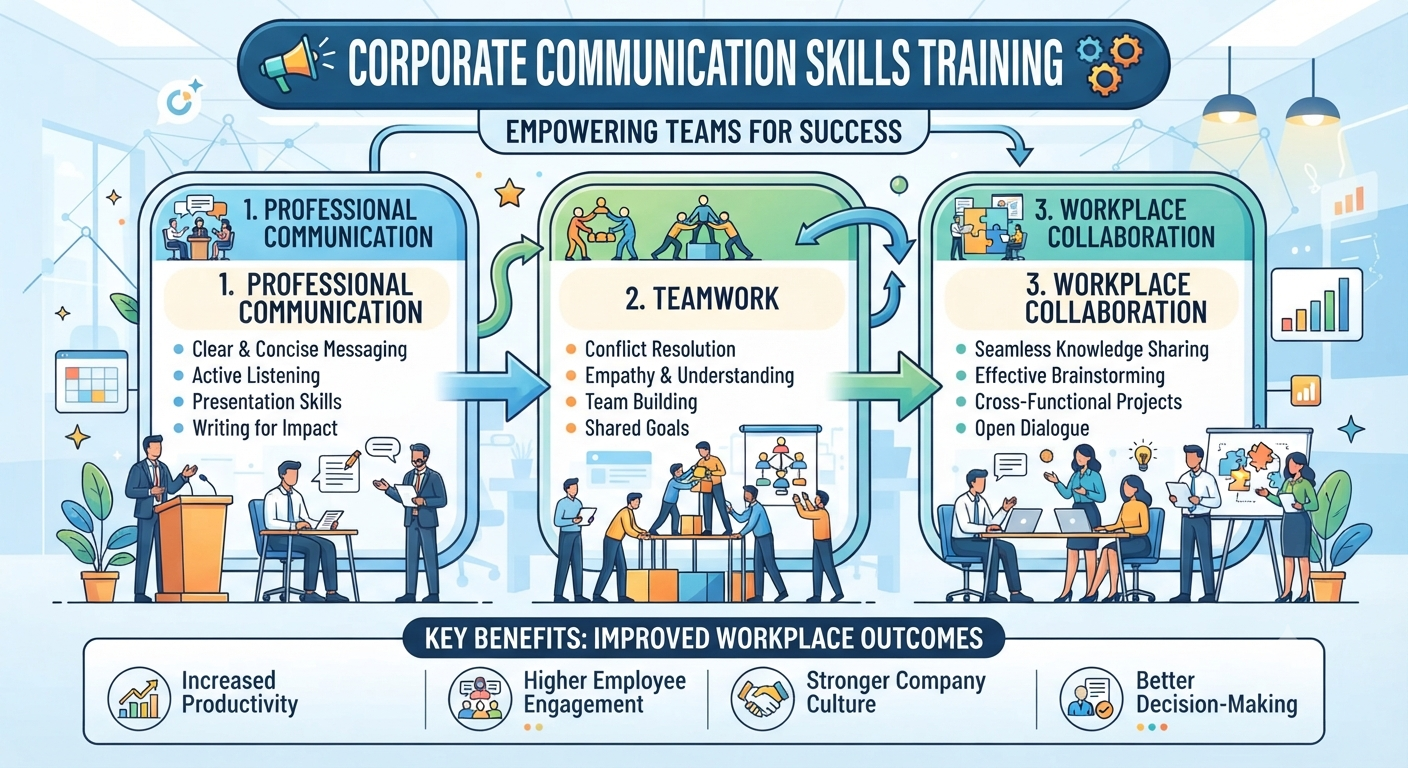
Strong communication serves as the fundamental bedrock of every high-performing team. Whether team members are collaborating on complex projects, navigating high-stakes problem-solving scenarios, or interacting with customers, their ability to convey ideas clearly directly dictates operational productivity and team dynamics.
When clear communication breaks down, organizations suffer from preventable misunderstandings, ambiguous expectations, and fractured cross-departmental alignment—all of which stall business momentum and drain overall workplace morale.
Communication skills training equips employees with the practical tools required to articulate thoughts confidently, engage in deliberate active listening, deliver actionable feedback, and collaborate seamlessly across all levels. By prioritizing communication development, organizations remove toxic friction from daily workflows, allowing teams to execute faster and operate with far greater alignment. Combining technical capability with refined interpersonal channels ultimately creates a high-trust, resilient organization built to achieve long-term, sustainable success.
Improves Team Collaboration
High-performing teams don’t just happen by chance—they run on clear, intentional channels of dialogue. When team members understand how to articulate their thoughts, ask the right questions, and stay aligned on daily operational priorities, friction vanishes. Refining these core interactions eliminates wasted effort and ensures every individual works toward shared objectives with total clarity and confidence.
Good communication allows team members to work together more efficiently.
Training helps employees:
- Share ideas clearly
- Understand team goals
- Coordinate tasks effectively
- Support one another
- Reduce misunderstandings
Better collaboration leads to higher productivity and stronger workplace relationships.
Reduces Workplace Misunderstandings
Unclear directions, assumptions, and ambiguous feedback are major contributors to costly operational errors and missed deadlines. Training provides teams with structured protocols to verify instructions, articulate complex ideas, and maintain complete alignment. By mastering these essentials, organizations eliminate guesswork and build a culture of operational precision.
Poor communication is one of the most common causes of workplace mistakes.
Communication training teaches employees how to:
- Express ideas clearly
- Confirm understanding
- Ask effective questions
- Provide accurate information
- Avoid unnecessary confusion
Clear communication helps projects move forward with fewer errors.
Strengthens Active Listening Skills
Effective dialogue is a two-way street; what is heard often matters far more than what is said. When employees prioritize genuine comprehension over simply formulating their next response, collaboration deepens. Mastering active listening transforms reactive workplace discussions into constructive, solution-oriented conversations.
Communication is not only about speaking—it also involves listening.
Employees learn to:
- Listen without interrupting
- Understand different perspectives
- Respond thoughtfully
- Clarify important information
- Build mutual respect
Active listening creates stronger teamwork and improves workplace relationships.
Builds Trust Among Team Members
Trust is the invisible force multiplier behind every resilient team, and it is forged entirely through daily communication habits. When employees feel safe sharing honest updates, delivering thoughtful feedback, and taking accountability without fear of judgment, psychological safety takes root—unlocking higher levels of team engagement and collective performance.
Teams perform better when employees trust one another.
Communication skills training encourages:
- Honest conversations
- Respectful feedback
- Open communication
- Accountability
- Transparency
Greater trust creates a more supportive and collaborative work environment.
Improves Conflict Resolution
Friction is bound to occur when diverse minds collaborate under tight deadlines and high expectations. However, unaddressed tension drains energy and halts momentum. Training gives employees the emotional framework and tactical phrasing needed to address issues early, keeping conversations professional, grounded, and focused on shared outcomes.
Disagreements are normal in every workplace.
Training helps employees:
- Stay calm during discussions
- Communicate respectfully
- Focus on solutions
- Resolve misunderstandings
- Maintain positive working relationships
Effective conflict resolution prevents small issues from becoming larger problems.
Increases Employee Confidence
Hesitation and self-doubt often silence valuable insights before they ever reach the table. When team members lack confidence, great ideas go unshared, and critical meetings fall flat. Communication training equips employees with the vocal presence, structure, and poise needed to speak up with authority and advocate for compelling solutions.
Employees who communicate confidently are more willing to contribute ideas and participate in discussions.
Communication training helps improve:
- Public speaking
- Meeting participation
- Presentation skills
- Professional conversations
- Confidence when sharing ideas
Confident employees often contribute more effectively to team success.
Enhances Leadership Communication
Leadership authority doesn’t come from a title; it is built through consistent, transparent, and purposeful interaction. When managers learn to translate high-level strategy into clear operational guidance, they eliminate confusion and inspire their teams to take ownership of results.
Strong communication is an essential leadership skill.
Managers and supervisors benefit by learning how to:
- Give clear instructions
- Provide constructive feedback
- Motivate team members
- Manage expectations
- Lead productive meetings
Effective leadership communication strengthens team performance.
Supports Better Customer Service
Internal communication standards naturally dictate external customer interactions; a team that communicates seamlessly behind the scenes projects authority and clarity outward. Training equips employees to listen empathetically, resolve client issues with poise, and maintain consistent brand messaging across every touchpoint.
Employees who communicate well internally are often better at communicating with customers.
Improved communication helps teams:
- Respond professionally
- Understand customer needs
- Resolve enquiries efficiently
- Deliver consistent service
- Build stronger customer relationships
Better communication contributes to higher customer satisfaction.
Encourages a Positive Workplace Culture
A positive culture isn’t built on slogans—it’s shaped by the daily standard of interaction across all levels of an organization. When employees feel safe sharing feedback, asking questions, and contributing without fear of judgment, psychological safety takes root, driving sustained engagement and long-term retention.
Open communication helps create a workplace where employees feel heard and valued.
Benefits include:
- Greater employee engagement
- Stronger teamwork
- Higher morale
- Better collaboration
- More inclusive discussions
A positive workplace culture supports long-term organizational success.
Signs Your Team Could Benefit from Communication Skills Training
Recognizing the signs of breakdown is the first step toward transforming your operational dynamics. When daily workflows are plagued by misaligned priorities, silent silos, and unproductive meetings, investing in structured communication training isn’t just an option—it is a business imperative to protect performance and retain talent.
Consider communication training if your organization experiences:
- ✔ Frequent misunderstandings
- ✔ Poor teamwork
- ✔ Low employee engagement
- ✔ Workplace conflicts
- ✔ Communication gaps between departments
- ✔ Ineffective meetings
- ✔ Declining productivity
Addressing these challenges early helps improve overall team performance.
Benefits of Communication Skills Training
Strategic investment in communication training delivers compounding returns across every operational level. By systematically refining how information flows, decisions are reached, and feedback is shared, organizations cultivate an agile workforce capable of executing strategic goals with speed and clarity.
Organizations that invest in communication training can:
- Improve teamwork
- Strengthen collaboration
- Increase productivity
- Build employee confidence
- Enhance leadership effectiveness
- Reduce workplace conflict
- Create a more positive work environment
These benefits contribute to stronger business performance over time.
Conclusion
ommunication skills training is an investment in both employees and organizational success. By improving active listening, collaboration, leadership communication, and conflict resolution, businesses can build stronger teams that work together more effectively.
Organizations that prioritize communication development create workplaces where employees feel confident, engaged, and motivated to achieve shared goals, leading to improved productivity and long-term business growth.
Ultimately, clear communication isn’t just a soft skill—it is the primary engine of operational excellence, turning day-to-day collaboration into sustainable competitive advantage.
FAQs
1. What are the key benefits of communication skills training for teams?
Communication skills training helps teams collaborate more effectively, reduce workplace misunderstandings, build trust, and resolve conflicts professionally. It also boosts employee confidence, enhances leadership effectiveness, and improves customer service quality.
2. How does communication training help reduce workplace errors and misunderstandings?
Training provides employees with structured protocols to express ideas clearly, confirm mutual understanding, ask targeted questions, and verify instructions. This eliminates guesswork and ensures tasks move forward with greater accuracy.
3. Why is active listening an essential part of communication skills training?
Effective communication relies heavily on listening. Active listening teaches employees to listen without interrupting, understand different perspectives, and clarify details, transforming potential friction into constructive, solution-oriented dialogue.
4. What signs indicate that an organization needs communication skills training?
Common warning signs include frequent misunderstandings, poor cross-departmental collaboration, unresolved workplace conflicts, low employee engagement, ineffective meetings, and declining productivity.
5. How does improving internal team communication impact customer service?
Internal communication standards directly reflect in customer interactions. Employees who communicate clearly internally are better equipped to listen empathetically, understand customer needs, resolve inquiries efficiently, and project consistent brand professionalism.