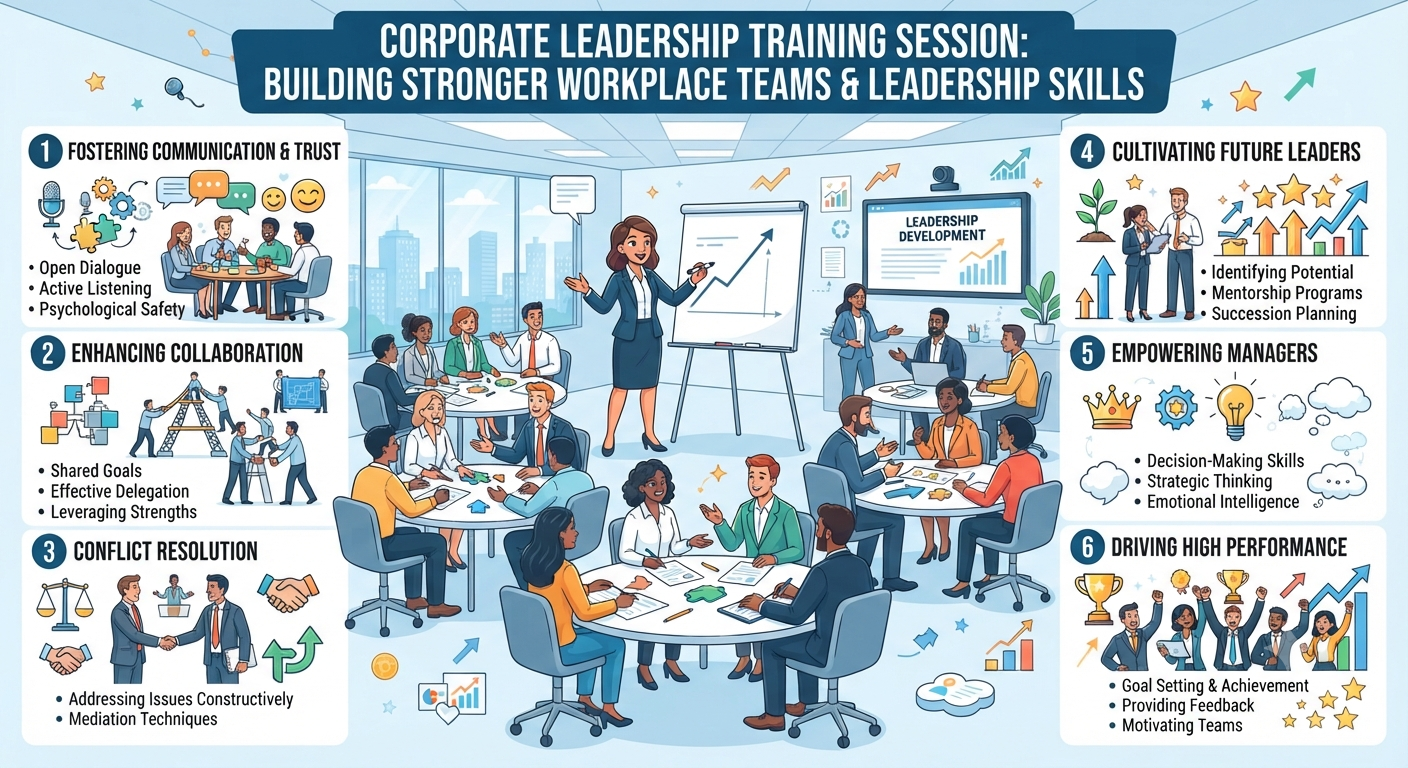
Strong workplace teams are built on far more than technical proficiency alone. While individual expertise drives task execution, sustainable organizational success depends on the fundamental pillars of effective communication, mutual trust, seamless collaboration, and strategic problem-solving—all of which require capable, forward-thinking leadership. Although certain leadership qualities naturally sharpen through years of hands-on experience, reliance on trial and error often leaves teams navigating unnecessary friction.
Structured leadership training bridges this gap by providing managers, supervisors, and emerging leaders with the deliberate frameworks and interpersonal skills required to guide their teams with confidence, consistency, and clarity.
Organizations that proactively invest in comprehensive leadership development programs consistently unlock measurable improvements in employee engagement, cross-functional teamwork, operational productivity, and overall business performance. By demystifying the art of team management, leadership training equips decision-makers to adapt their management styles to diverse team dynamics, articulate high-level objectives without ambiguity, and cultivate a supportive environment where individual employees feel empowered to perform at their absolute best.
Ultimately, developing stronger leaders is not merely an HR initiative; it is the most direct path to building resilient, aligned, and future-ready teams capable of driving long-term organizational success.
Improves Communication Skills
Exceptional team performance relies on absolute clarity, and that clarity starts at the top. When leaders learn to articulate expectations, deliver feedback with precision, and create a culture of intentional dialogue, operational friction vanishes. Refined leadership communication replaces ambiguity with trust, ensuring every team member stays aligned, motivated, and empowered to execute shared business goals with confidence.
Effective leaders know how to communicate clearly and consistently.
Leadership training helps managers:
- Deliver clear expectations
- Provide constructive feedback
- Listen actively
- Encourage open discussions
- Reduce workplace misunderstandings
Better communication creates stronger relationships between leaders and their teams.
Builds Trust Within Teams
High-performing teams do not operate at their full potential without a baseline of psychological safety and reliable guidance. When leaders act with consistency and integrity, team members feel secure taking initiative, raising concerns, and pushing for innovation. Structured leadership development instills the core behaviors needed to turn trust from a vague concept into a tangible daily standard.
Trust is one of the foundations of a high-performing workplace.
Leadership training teaches leaders how to:
- Lead by example
- Demonstrate accountability
- Build credibility
- Support team members
- Create psychological safety
When employees trust their leaders, they are more likely to collaborate and contribute confidently.
Strengthens Team Collaboration
Seamless cross-functional alignment does not happen by accident; it requires leaders who know how to break down operational silos and unite individuals around a unified mission. When managers actively facilitate open communication and leverage the unique talents of every team member, collective performance rises, turning isolated efforts into high-impact business results.
Successful organizations depend on employees working together toward shared goals.
Leadership development encourages managers to:
- Promote teamwork
- Encourage knowledge sharing
- Recognize individual strengths
- Foster cooperation
- Improve coordination between departments
Stronger collaboration leads to more efficient and productive teams.
Enhances Problem-Solving Abilities
Navigating unexpected hurdles, operational shifts, and interpersonal friction requires a steady, analytical hand at the helm. When unexpected obstacles arise, unprepared managers often react with hesitation or anxiety, which can quickly ripple through an entire department. Leadership training provides managers with the strategic tools to maintain composure, evaluate risk, and turn workplace challenges into opportunities for growth.
Challenges are part of every workplace.
Leadership training equips leaders to:
- Analyze situations objectively
- Make informed decisions
- Solve conflicts constructively
- Respond to change effectively
- Guide teams through difficult situations
Confident decision-making helps teams remain focused during challenges.
Increases Employee Engagement
Disengaged employees rarely suffer from a lack of talent—they suffer from a lack of meaningful connection to their work and leadership. When managers take a proactive approach to acknowledging contributions, providing mentorship, and aligning individual aspirations with company goals, workplace culture shifts dramatically. Leadership development gives supervisors the tools to transform routine oversight into empowering, high-engagement management.
Employees are more engaged when they feel supported and valued.
Effective leaders learn how to:
- Recognize achievements
- Motivate team members
- Encourage participation
- Build positive workplace relationships
- Create opportunities for growth
Higher engagement often results in better performance and lower staff turnover.
Develops Future Leaders
Sustainable organizational growth depends on a continuous pipeline of capable talent ready to step up when new challenges emerge. Waiting to train managers until after they assume executive roles creates operational friction and delays execution. Developing leadership capabilities early across all levels builds a resilient workforce, lowers recruitment costs, and ensures smooth succession planning for the future.
Leadership training is not only for senior management.
Organizations can prepare future leaders by helping employees develop:
- Communication skills
- Decision-making abilities
- Confidence
- Responsibility
- Leadership potential
Developing internal talent supports long-term organizational success.
Improves Conflict Management
Left unaddressed, minor workplace friction can quickly spiral into toxic team dynamics and lost productivity. Effective leaders don’t avoid difficult conversations; they master the art of turning potential disputes into opportunities for alignment. Leadership training provides managers with practical techniques to de-escalate tension, focus on objective solutions, and preserve strong working relationships across the entire team.
Workplace disagreements are unavoidable, but they can be managed effectively.
Leadership training helps managers:
- Address conflicts early
- Encourage respectful discussions
- Find practical solutions
- Maintain team relationships
- Prevent small issues from escalating
Healthy conflict resolution strengthens team cohesion.
Encourages Adaptability
Rapid technological advances and shifting market dynamics mean that static management approaches quickly become liability. Leaders who lack the skills to navigate uncertainty risk stalling progress and overwhelming their teams during pivotal transitions. Leadership training gives managers the agility to lead through disruption, foster a mindset of continuous innovation, and steer their organizations confidently into the future.
Modern workplaces continue to evolve with new technologies and changing business needs.
Leadership training prepares leaders to:
- Manage organizational change
- Support employees during transitions
- Encourage innovation
- Adapt management styles
- Build resilient teams
Adaptable leaders help organizations respond more effectively to change.
Creates a Positive Workplace Culture
Organizational culture is never defined by corporate values on a poster; it is modeled daily through the behavior and choices of its managers. When supervisors consistently operate with transparency, fairness, and mutual respect, those habits permeate the entire workplace environment. Structured leadership development ensures managers actively cultivate an environment where every employee feels safe, respected, and driven to contribute their best work.
Leadership has a direct influence on workplace culture.
Well-trained leaders contribute by:
- Encouraging respect
- Promoting accountability
- Supporting diversity and inclusion
- Recognizing employee contributions
- Leading with integrity
A positive culture improves morale and strengthens teamwork.
Signs Your Organization Could Benefit from Leadership Training
Recognizing these operational warning signs early is essential to protecting your company’s bottom line and organizational health. When leadership is inconsistent, friction compounds rapidly—manifesting as misaligned priorities, burned-out staff, and stagnant growth. Investing in targeted leadership development addresses the root causes of these inefficiencies, transforming systemic friction into a cohesive, high-performing workplace culture.
You may want to consider leadership development if your organization experiences:
- ✔ Poor communication between teams
- ✔ Low employee engagement
- ✔ Frequent workplace conflicts
- ✔ High staff turnover
- ✔ Inconsistent management practices
- ✔ Difficulty adapting to change
- ✔ Low team productivity
Leadership training can address many of these challenges before they affect long-term business performance.
Benefits of Leadership Training
Strategic investment in leadership development delivers compounding benefits across every layer of an enterprise. By equipping supervisors and managers with actionable management frameworks, organizations build a resilient workforce capable of driving performance today while safeguarding the talent pipeline for tomorrow.
Investing in leadership development helps organizations:
- Build stronger workplace teams
- Improve communication
- Increase employee engagement
- Strengthen collaboration
- Develop future leaders
- Improve problem-solving
- Support sustainable business growth
Strong leadership creates an environment where both employees and businesses can succeed.
Conclusion
Ultimately, an organization’s competitive advantage is determined not just by its products or services, but by the caliber of the leaders guiding its workforce. Empowering managers with structured training transforms everyday operational challenges into opportunities for growth, cohesion, and sustained excellence. By turning supervisors into capable, empathetic leaders, companies lay an unbreakable foundation for a thriving, future-ready workplace.
Leadership training plays an essential role in building stronger workplace teams. By improving communication, strengthening trust, developing problem-solving skills, and encouraging collaboration, organizations can create a more productive and positive work environment.
Businesses that invest in leadership development are better equipped to support employee growth, improve workplace performance, and build resilient teams that contribute to long-term organizational success.
FAQs
1. How does leadership training help improve communication across workplace teams?
Leadership training equips managers with the tools to deliver clear expectations, provide constructive feedback, listen actively, and foster open dialogue. Refining these communication skills replaces ambiguity with trust and drastically reduces workplace misunderstandings, keeping teams aligned on shared objectives.
2. In what ways can leadership training strengthen trust and collaboration within a team?
Leadership training teaches managers to lead by example, demonstrate accountability, build credibility, and create psychological safety. When leaders act with consistency, team members feel secure to collaborate, share knowledge across departments, and contribute confidently toward unified goals.
3. Why is conflict management an important part of leadership development?
Left unaddressed, minor workplace friction can escalate into toxic team dynamics and lost productivity. Leadership training helps managers address disputes early, facilitate respectful discussions, and focus on practical, objective solutions while preserving strong working relationships.
4. How does leadership training assist managers during periods of organizational change?
Modern workplaces continuously evolve with changing technological and business needs. Training prepares leaders to manage change smoothly, support employees during transitions, adapt their management styles, and cultivate resilient teams that embrace innovation rather than resisting it.
5. What operational signs indicate that an organization needs leadership training?
Common warning signs include poor communication between departments, low employee engagement, frequent workplace conflicts, high staff turnover, inconsistent management practices, difficulty adapting to change, and stagnant team productivity.