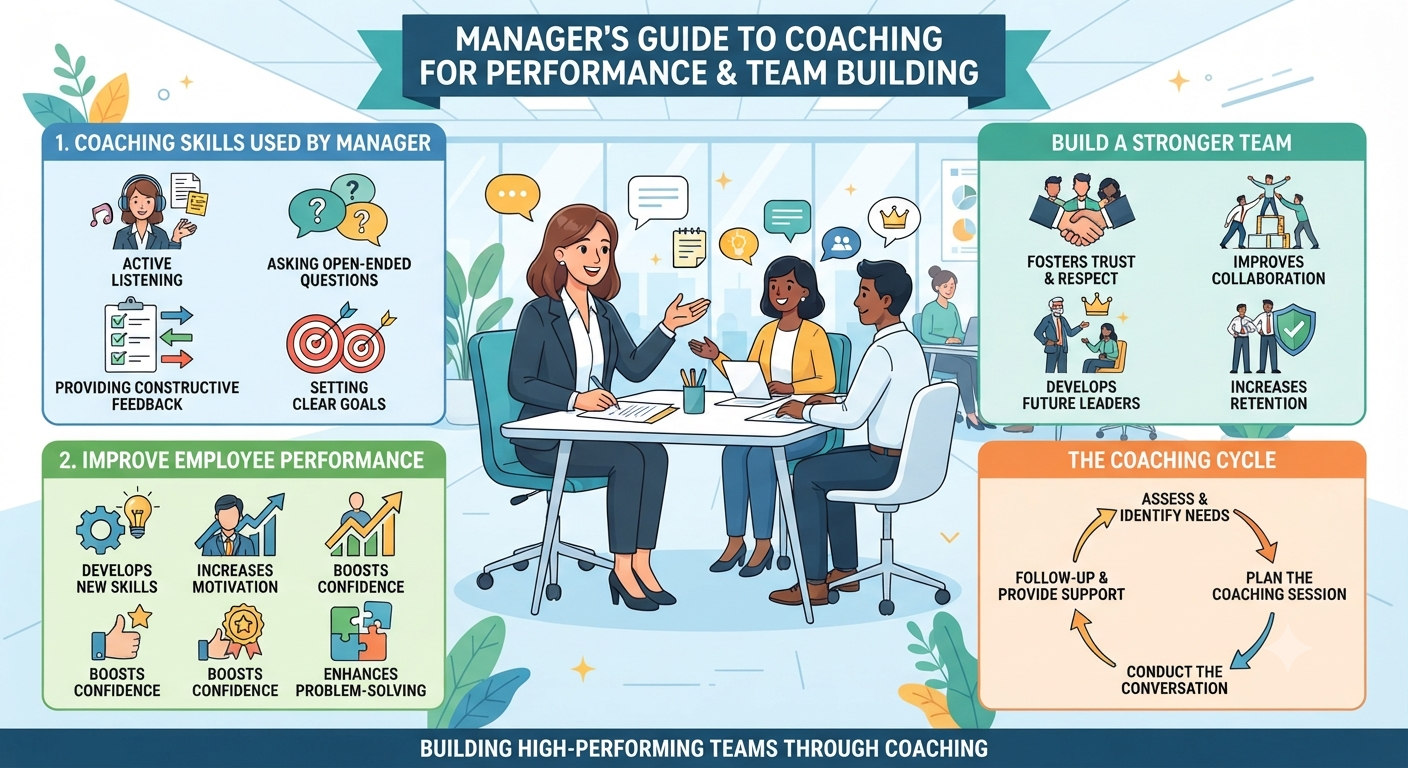
Modern workplaces demand far more than traditional managers who simply delegate assignments, track deadlines, and monitor day-to-day performance. In today’s fast-paced business environment, effective leadership requires the ability to guide, support, and actively develop employees to reach their fullest potential and achieve superior business results. This shift makes coaching skills essential for leaders navigating modern team dynamics.
Rather than relying on rigid top-down directives, a coaching approach allows managers to uncover individual strengths, encourage personal and professional growth, deliver actionable feedback, and cultivate a supportive culture where employees feel genuinely motivated to excel.
By prioritizing active development over simple oversight, leaders foster psychological safety and build the confidence necessary for continuous innovation. Coaching transforms routine operational check-ins into meaningful development opportunities, replacing micro-management with empowered autonomy. Ultimately, managers who dedicate time to honing their coaching skills do far more than improve daily productivity—they forge higher-performing, resilient teams that possess the trust, accountability, and adaptability needed to drive long-term organizational success.
What Are Coaching Skills for Managers?
Leadership in modern organizations requires a fundamental shift from commanding to facilitating. While traditional management often relies on telling employees exactly what to do and how to do it, true performance optimization stems from unlocking an individual’s potential to maximize their own capability. By integrating core coaching competencies into daily interactions, leaders create an environment centered on curiosity, self-reflection, and continuous learning rather than strict compliance.
Instead of only giving instructions, coaching-focused managers guide employees through:
- Asking meaningful questions
- Providing constructive feedback
- Encouraging problem-solving
- Supporting professional development
- Building confidence
This approach helps employees become more independent and take greater ownership of their responsibilities.
Develop Stronger Employee Performance
When managers shift from a mindset of constant supervision to one of intentional development, they transform performance reviews into proactive growth opportunities. By stepping back to guide employees through self-assessment and practical skill-building, leaders create a clear path for sustainable professional excellence.
Managers who coach their teams can help employees:
- Identify areas for improvement
- Set realistic goals
- Develop new skills
- Overcome workplace challenges
- Improve confidence
Rather than simply pointing out mistakes, coaching helps employees understand how they can grow and perform better.
Build Trust Between Managers and Employees
By prioritizing authentic engagement over rigid control, managers forge meaningful connections that transform everyday workplace interactions into strong, trust-based partnerships.
Trust is an important foundation of a successful team. A manager who uses coaching skills creates stronger relationships by:
- Listening to employee concerns
- Showing empathy
- Providing support
- Encouraging open communication
- Respecting different perspectives
When employees feel supported by their managers, they are more likely to share ideas, ask questions, and contribute actively.
Encourage Employee Growth and Development
Sustainable organizational growth depends entirely on continuous learning and adaptability rather than static talent. When managers act as coaches, they shift from simply monitoring outputs to actively investing in employee capabilities, creating a culture of perpetual improvement. By taking the time to understand each team member’s unique skills and professional aspirations, leaders can strategically align personal growth with broader business objectives.
Coaching helps managers identify:
- Individual strengths
- Development opportunities
- Career goals
- Areas where employees need support
By helping employees reach their potential, managers create a team that continues to improve over time.
Improve Communication Within Teams
When leaders incorporate coaching principles into their daily management style, they move past one-way instructions toward collaborative, high-value exchanges. By shifting the focus from telling to inquiring, managers unlock deeper insights, eliminate hidden friction points, and build alignment across every level of the organization.
Coaching encourages managers to:
- Listen actively
- Ask open-ended questions
- Give clear feedback
- Understand employee perspectives
- Have meaningful conversations
Better communication reduces misunderstandings and helps teams work together more effectively.
Increase Employee Motivation and Engagement
When managers step into the role of a coach, they move beyond basic supervision to actively nurture enthusiasm, effort, and innovation within their teams. By taking an intentional interest in individual contributions and offering meaningful support, leaders transform routine work into a shared mission, inspiring employees to take pride in their performance.
Coaching skills allow managers to:
- Encourage employees
- Recognise achievements
- Provide guidance
- Support new ideas
- Create a positive working environment
A supportive management style helps employees become more engaged and committed to achieving team goals.
Help Teams Solve Problems Independently
By adopting a coaching mindset, leaders shift from prescribing fixes to guiding employees through their own analytical processes, equipping team members with the confidence and autonomy needed to resolve complex issues independently.
Traditional management often focuses on giving solutions immediately. However, coaching encourages employees to think critically and find solutions themselves. Managers can support problem-solving by asking questions such as:
- What challenges are you facing?
- What solutions have you considered?
- What resources do you need?
- What steps can you take next?
This develops employee confidence and reduces dependence on managers for every decision.
Create Future Leaders Within the Organisation
Long-term organizational stability relies on a forward-thinking leadership strategy that balances immediate deliverables with future workforce readiness. By incorporating coaching into daily management, leaders turn current workflows into continuous learning experiences, ensuring employees systematically build the competencies required for advancement.
Through coaching, managers can help employees develop:
- Leadership abilities
- Decision-making skills
- Confidence
- Communication skills
- Problem-solving abilities
Developing internal talent creates a stronger leadership pipeline for the organisation.
Reduce Micromanagement
Transitioning to a coaching-based management style breaks this restrictive cycle by shifting the focus from monitoring tasks to empowering people, fostering an adaptable team culture built on trust and self-reliance.
Micromanagement can limit creativity and reduce employee confidence. A coaching leadership style allows managers to:
- Provide guidance instead of control
- Trust employees with responsibilities
- Encourage ownership
- Support independent decision-making
When employees are empowered, teams become more productive and adaptable.
Build a Positive Workplace Culture
When leaders default to command-and-control tactics, toxic silos and competitive anxiety quickly take root. Conversely, when managers consistently apply coaching principles across all levels, they build a supportive environment where continuous growth, mutual respect, and shared goals define the daily workplace experience.
Benefits include:
- Stronger teamwork
- Better collaboration
- Increased trust
- Improved employee satisfaction
- Continuous learning
A positive culture encourages employees to work together and support each other’s success.
Why Businesses Should Invest in Coaching Skills Training
Equipping leaders with formal coaching capabilities bridges this gap, transforming technical supervisors into influential facilitators who can systematically unlock potential across their teams.
Coaching skills training helps managers develop the ability to lead people more effectively. The benefits include:
- Improved employee performance
- Stronger manager-employee relationships
- Better communication
- Higher team engagement
- More confident employees
- Stronger leadership development
Investing in coaching skills helps organisations create managers who can inspire teams and achieve sustainable business growth.
Conclusion
Coaching skills are essential for managers who want to build high-performing teams. By focusing on guidance, communication, feedback, and employee development, managers can create an environment where people feel supported and motivated to succeed.
A manager who coaches does more than manage daily tasks—they help employees grow, improve teamwork, and create a stronger organisation for the future.
Ultimately, organizations that embed coaching into their managerial DNA position themselves to thrive in an ever-changing corporate landscape. By prioritizing open communication, personal development, and supportive guidance, leaders cultivate self-reliant employees and high-performing teams capable of driving continuous success for years to come.
FAQs
1. What are coaching skills for managers and how do they differ from traditional management?
Coaching skills are capabilities managers use to help employees improve performance, develop skills, and achieve goals through guidance, asking meaningful questions, and providing constructive feedback
2. How do coaching skills improve employee performance and growth?
Coaching transforms performance evaluations into proactive development opportunities. Managers who coach help employees identify areas for improvement, set realistic goals, overcome challenges, and build new skills. It also aligns individual career goals and strengths with broader business objectives, encouraging continuous learning across the team.
3. In what ways does a coaching approach help managers reduce micromanagement?
A coaching leadership style shifts the focus from rigid control and task-monitoring to empowering people. By trusting employees with responsibilities, supporting independent decision-making, and guiding rather than controlling, managers foster a productive environment built on self-reliance.
4. How does coaching encourage teams to solve problems independently?
Instead of offering immediate fixes, managers with coaching skills ask open-ended questions—such as asking what challenges exist or what steps can be taken next—to encourage critical thinking. This guides employees to evaluate options and solve problems on their own, boosting confidence and reducing constant reliance on management.
5. Why should businesses invest in formal coaching skills training for their managers?
Coaching skills training transforms supervisors into effective facilitators who can unlock employee potential. Organizations that invest in coaching training experience improved employee performance, stronger trust between managers and teams, better communication, higher engagement, and a robust internal leadership pipeline for long-term growth.