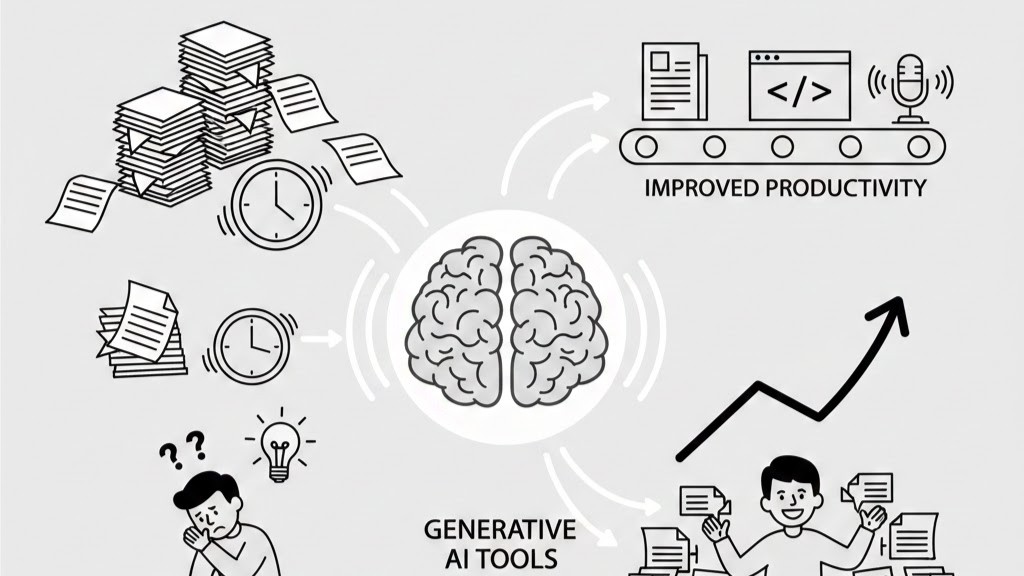
Modern workplaces demand continuous efficiency, creative problem-solving, and rapid adaptation to emerging technologies. Managing daily workloads while maintaining high performance standards often leads to operational bottlenecks and professional burnout. Fortunately, advancements in artificial intelligence have opened new avenues for optimizing time management and streamlining complex operations.
Adopting generative AI tools allows individuals and organizations to rethink standard workflows entirely. Instead of spending long hours on manual execution, professionals can delegate routine work to intelligent systems. Integrating ChatGPT generative AI tools into daily routines empowers workers to complete projects faster, reduce administrative burden, and maintain exceptional quality.
What Are ChatGPT Generative AI Tools?
ChatGPT generative AI tools refer to specialized software applications, custom models, and system integrations powered by advanced Large Language Models (LLMs).
During daily operations, these intelligent tools process complex user inputs to execute tasks across various domains, including:
- Natural language generation
- Document summarization
- Data extraction and restructuring
- Content editing and polishing
- Multilingual translation
- Code writing and debugging
- Automated email drafting
- Conceptual brainstorming
The primary goal of these AI platforms is to act as virtual collaborators that augment human intellect, accelerate project timelines, and simplify multi-step business procedures.
Why Generative AI Is Essential for Modern Productivity
Not every task requires manual drafting from scratch, and traditional software tools often lack contextual understanding. Without intelligent support, workers spend excessive time on low-value repetitive processes.
Leveraging ChatGPT generative AI tools enables users to:
- Eliminate starting-page fatigue by generating instant initial drafts
- Process lengthy reports and documents in seconds
- Reduce cognitive load during complex decision-making
- Standardize business communications across departments
- Automate routine administrative responses
- Scale content output without expanding team size
Early adoption of AI workflows helps businesses and individual professionals remain highly competitive in an increasingly fast-paced global economy.
Identifying Everyday Workflow Bottlenecks
Integrating AI solutions effectively requires identifying high-friction tasks within daily operations.
Common efficiency obstacles that generative AI can eliminate include:
- Sorting and summarizing lengthy email threads
- Sifting through extensive research papers or market reports
- Drafting repetitive promotional materials or social media posts
- Converting unstructured notes into actionable meeting minutes
- Formatting and cleaning raw data entries
- Debugging technical code line by line
- Translating documentation for global communication
- Outlining complex strategic proposals from scratch
Addressing these friction points with automated tools frees up mental bandwidth for high-impact strategic initiatives.
Transforming Daily Content Creation and Communication
Content generation consumes a significant portion of the workday for professionals in marketing, human resources, sales, and management.
Without automated assistance, heavy communication demands can cause:
- Inconsistent messaging across corporate communications
- Delayed email responses and missed follow-ups
- Creative blocks when writing original copy
- Grammatical inconsistencies in technical documents
- Time lost during repetitive revisions and proofreading
- Misaligned tone across different distribution channels
Implementing generative AI tools mitigates these operational friction points by delivering instant, context-aware suggestions and polished content drafts tailored to specific target audiences.
Accelerating Research and Information Synthesis
Generative AI acts as an advanced research assistant capable of digesting massive quantities of text.
AI-assisted research workflows allow teams to:
- Extract key takeaways from hundred-page PDF documents
- Compare multiple market reports instantly
- Condense complex academic studies into plain language
- Generate targeted research briefs for rapid decision-making
- Synthesize qualitative customer feedback into core themes
- Monitor industry shifts through automated content analysis
Faster synthesis enables business leaders to formulate strategies backed by insights without spending days on preliminary reading.
The Role of Effective Prompt Engineering
Achieving optimal output quality relies heavily on how instructions are delivered to AI systems.
Core techniques for mastering prompt engineering include:
- Assigning clear personas and roles to the AI model
- Providing explicit background context and objectives
- Setting specific constraints on output length, style, and tone
- Supplying sample reference text for formatting guidance
- Breaking complex instructions into step-by-step prompts
- Using iterative feedback loops to refine preliminary responses
Understanding prompt structure transforms standard AI responses into highly accurate, business-ready assets.
Why Professional AI Integration Beats Unstructured Use
While basic conversational AI use offers occasional convenience, systematic workflow integration provides sustainable enterprise value.
Structured AI implementation ensures:
- Standardized security and data privacy measures
- Uniform quality standards across team outputs
- Seamless connection with existing business software via API integrations
- Automated triggers for repetitive, multi-app processes
- Reduced risk of factual hallucinations or incorrect outputs
Proper training and clear operational guidelines maximize return on investment while safeguarding sensitive corporate information.
Enterprise Departments Benefiting from Generative AI
Business units across diverse industries leverage generative AI to automate workflows and optimize outputs.
Key departmental applications include:
Finance and Accounting
Automating report cleanup, consolidating financial summaries, and generating scenario narratives.
Human Resources
Drafting comprehensive job descriptions, screening applicant profiles, and creating policy onboarding guides.
Sales and Marketing
Generating personalized email outreach, creating campaign copy, and analyzing sales pipeline trends.
Customer Support
Auto-generating quick response templates, summarizing ticket histories, and translating queries.
Software Engineering
Writing boilerplate code, generating technical documentation, and analyzing syntax errors.
Broad adoption across divisions creates a synchronized, highly agile corporate environment.
When yo Implement Generative AI Workflows
Organizations and professionals should evaluate their readiness for AI integration when:
- Teams spend more time on administrative upkeep than core tasks
- Scaling operations without increasing overhead cost becomes a priority
- Rapid content production deadlines consistently strain creative resources
- Large volumes of unstructured data need systematic categorization
- Cross-border operations require ongoing translation and localization
- Onboarding processes require structured, accessible knowledge repositories
Proactive implementation builds long-term organizational agility and technical resilience.
Long-Term Benefits of ChatGPT Generative AI Integration
Investing time into mastering ChatGPT generative AI tools yields compounding performance advantages.
Key organizational advantages include:
☑ Significant time savings on repetitive weekly tasks
☑ Higher quality, polished drafts delivered in record time
☑ Lower operational costs across content and administrative pipelines
☑ Accelerated employee onboarding and rapid skill development
☑ Improved cross-departmental collaboration and communication clarity
☑ Greater bandwidth for innovation and high-level strategic thinking
☑ Scalable business processes that adapt effortlessly to growth
☑ Enhanced professional satisfaction through reduced mundane workload
Focusing on strategic AI enablement transforms daily output from reactive maintenance to proactive value creation.
Choosing the Right AI Tools and Platform Architecture
Selecting the right generative AI ecosystem requires evaluating specific business requirements and workflow complexity.
Key criteria to evaluate include:
- Platform versatility and model customization options
- Integration support for daily tools like spreadsheets, databases, and CRMs
- Data protection policies and enterprise-grade compliance features
- Model processing speed and uptime reliability
- User interface accessibility for non-technical team members
- Vendor ecosystem updates and ongoing support services
Selecting secure, intuitive, and scalable solutions ensures long-term operational success and seamless user adoption.
Conclusion
Unlocking faster, smarter productivity with ChatGPT generative AI tools is no longer a distant possibility—it is a critical advantage in today’s modern professional landscape. By identifying manual bottlenecks, mastering prompt engineering, and integrating AI across daily operations, professionals and enterprises can achieve unprecedented levels of efficiency.
Whether for personal task management, marketing content production, coding support, or enterprise-wide operational optimization, generative AI provides the modern engine for sustained growth. Embracing these intelligent tools allows teams to work wiser, minimize unnecessary stress, and focus their energy on high-value innovations that drive long-term strategic success.
FAQs
1. What are ChatGPT generative AI tools?
ChatGPT generative AI tools are software applications, plugins, and custom models powered by advanced Large Language Models that generate text, code, ideas, and data analysis based on natural language prompts to automate everyday business tasks.
2. How do generative AI tools boost personal and business productivity?
Generative AI boosts productivity by automating repetitive tasks like email drafting, document summarization, research analysis, content creation, and basic code debugging, allowing workers to complete assignments in a fraction of the time.
3. Can non-technical professionals use ChatGPT for workflow automation?
Yes. Modern ChatGPT interfaces and generative AI tools utilize plain, natural language prompts, enabling non-technical professionals across HR, sales, marketing, and finance to design automated workflows without writing software code.
4. What is prompt engineering and why is it important?
Prompt engineering is the practice of crafting clear, contextual, and structured instructions for AI models. Mastering prompt engineering ensures the AI provides highly accurate, context-aware, and business-ready outputs on the first attempt.
5. How can a business safely integrate ChatGPT tools into daily operations?
Safe integration involves selecting enterprise-grade AI platforms with strict data privacy protocols, setting operational guidelines for AI usage, training staff on effective prompting, and verifying output quality before final execution.